Grading the Conservative Movement on Constitutional Fidelity: Where We Shine and Where We Stumble
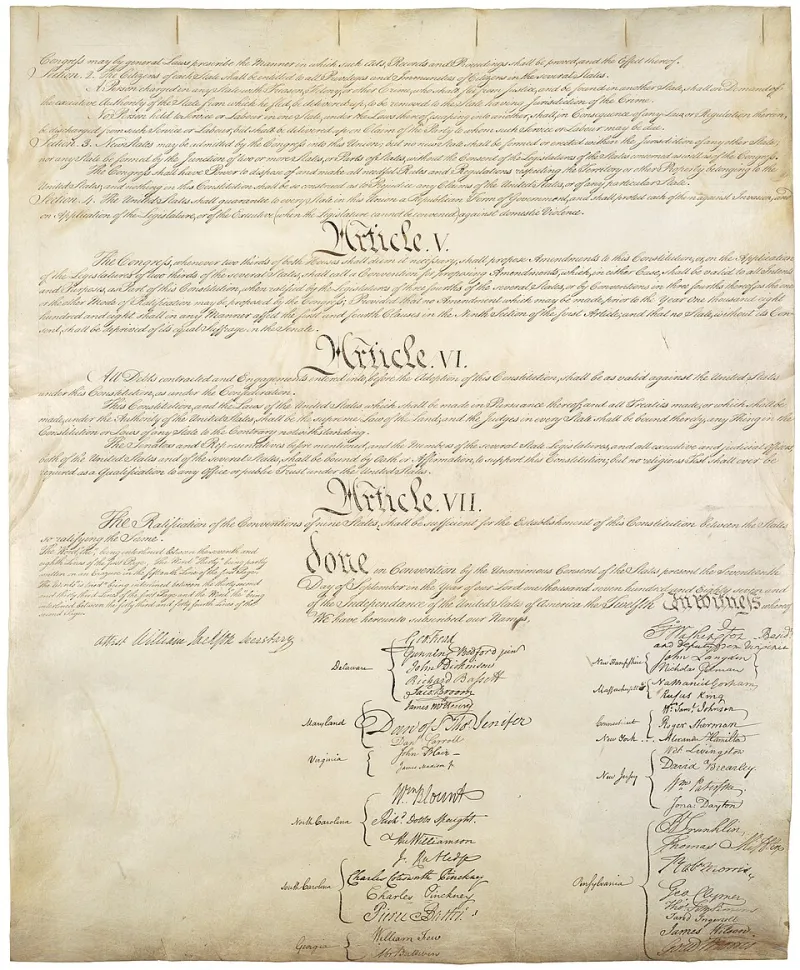
Photo: Constitutional Convention, Public domain, via Wikimedia Commons
Conservatism's greatest strength — and, at times, its most glaring vulnerability — is the centrality of the Constitution to its political identity. Unlike the progressive left, which treats the founding document as a living artifact to be reinterpreted in light of contemporary preferences, conservatives have historically insisted that the Constitution means what it says, that its structure was deliberately designed, and that departing from its text and original understanding is not reform but corruption.
That is a noble commitment. It is also one that demands rigorous self-examination. If constitutional fidelity is the standard by which we judge our opponents, it must also be the standard by which we judge ourselves. What follows is an honest accounting — five foundational principles evaluated not against the rhetorical claims of the conservative movement, but against the actual record of conservative governance.
Principle One: Federalism — Strong Rhetoric, Inconsistent Application
Grade: B-
Federalism — the constitutional architecture that reserves significant governing authority to the states — is perhaps the principle conservatives invoke most frequently and honor most inconsistently. The Tenth Amendment's declaration that powers not delegated to the federal government belong to the states and the people is a conservative rallying cry in virtually every election cycle.
And yet the record is mixed. Conservatives have been rightfully commended for resisting federal overreach in areas like education, where the push for local control over curriculum and school choice represents genuine federalist conviction. The post-Dobbs landscape, which returned the abortion question to state legislatures where it constitutionally belongs, is a landmark federalist achievement — one that took decades of patient judicial appointments and legal advocacy to realize.
But the picture darkens when federal power serves conservative policy preferences. Mandatory minimum sentencing schemes, federal intervention in state marijuana laws, and certain immigration enforcement mechanisms have all drawn conservative support despite raising serious questions about the appropriate division of authority. Federalism cannot be a principle of convenience. It must apply even — especially — when state-level decisions produce outcomes we dislike. The movement earns high marks for its rhetoric on this front and somewhat lower marks for its consistency.
Principle Two: Separation of Powers — An Underappreciated Battleground
Grade: C+
The Constitution's distribution of legislative, executive, and judicial authority among three distinct branches was not an accident of historical circumstance. It was a deliberate safeguard against the concentration of power that the Founders had witnessed and feared. Conservatives have been vocal defenders of judicial independence and legislative prerogative when those institutions have served as checks on progressive executive action.
The more difficult question is whether conservatives have applied equal rigor when the executive branch expanding its authority serves their own policy objectives. The broad use of executive orders, emergency declarations, and administrative rulemaking — tools that conservatives rightly criticized during the Obama years — did not disappear when Republican administrations took office. The temptation to achieve through executive action what cannot be accomplished through legislation is powerful, and it is a temptation that both parties have indulged.
Conservatives who care about constitutional structure must be willing to make the harder argument: that the proper remedy for legislative gridlock is not executive improvisation, but the laborious, frustrating work of building legislative coalitions and winning elections at every level of government. The separation of powers was designed to be inefficient. That inefficiency is a feature, not a flaw.
Principle Three: Limited Government — The Movement's Foundational Commitment, Under Pressure
Grade: B
The proposition that government should be small, its powers enumerated, and its reach limited is the philosophical core of American conservatism. On spending and regulatory restraint, conservatives have made genuine progress in framing the debate, if not always in winning it. The push for regulatory reform, the resistance to expansive administrative agencies, and the effort to return government functions to private markets all reflect authentic limited-government conviction.
The challenge is fiscal. Federal spending has grown under administrations of both parties, and the national debt — now exceeding $34 trillion — represents a profound failure of limited-government principle that cannot be attributed solely to the left. Entitlement reform remains the third rail that too many conservative politicians refuse to touch, preferring the political safety of rhetorical commitment to limited government over the harder work of actually limiting it.
The movement deserves credit for the instinct and the framework. It must do better on the follow-through, particularly on the spending side of the ledger, where the gap between conservative rhetoric and conservative governance has been most conspicuous.
Principle Four: Individual Rights and Due Process — A Genuine Conservative Strength
Grade: A-
On the protection of individual rights enumerated in the Bill of Rights, the modern conservative movement has compiled a record that deserves genuine commendation. The robust defense of Second Amendment rights, culminating in landmark Supreme Court decisions affirming an individual right to keep and bear arms, represents decades of principled legal and political advocacy paying tangible dividends.
Conservatives have also been strong defenders of religious liberty — the First Freedom, as it is rightly called — pushing back against regulatory and judicial encroachments on the rights of believers to live and operate their businesses in accordance with their faith. The legal battles fought on behalf of small business owners, religious schools, and faith-based organizations represent constitutional conservatism at its most admirable.
The area requiring greater vigilance is due process in the criminal justice context, where some conservative voices have been too quick to subordinate procedural protections to prosecutorial efficiency. The presumption of innocence and the right to a fair trial are not liberal constructs — they are ancient liberties that conservative jurisprudence should protect with the same tenacity applied to the rights enumerated in the Second and First Amendments.
Principle Five: The Rule of Law — The Non-Negotiable Foundation
Grade: Incomplete
No constitutional principle is more foundational than the rule of law — the proposition that law governs all persons equally, that no individual stands above its reach, and that outcomes in legal proceedings are determined by evidence and precedent rather than political loyalty or institutional convenience.
This principle is where the contemporary conservative movement faces its most searching examination, and where the grade cannot yet be finalized. The politicization of legal proceedings, the willingness of some conservative voices to question the legitimacy of judicial outcomes they dislike, and the rhetorical attacks on law enforcement institutions that had previously enjoyed strong conservative support have introduced a troubling dissonance into the movement's constitutional profile.
Conservatives who believe in the rule of law must apply that belief symmetrically. A movement that demands accountability from progressive institutions but excuses departures from legal norms when they benefit its preferred figures is not a constitutional movement — it is a partisan one dressed in constitutional clothing.
The Path Forward
None of this critique is offered in the spirit of defeatism or disloyalty to conservative principles. Quite the opposite. The movement's constitutional commitments are its most powerful and enduring asset — the source of its moral authority and its greatest gift to the republic. But that asset must be earned through consistent application, honest self-assessment, and the courage to hold our own leaders to the same standard we demand of our opponents.
The Founders did not build a perfect system. They built a durable one — one capable of correcting its own errors when the people who inhabit it possess the virtue and the vigilance to demand it. That demand must come from within the conservative movement with as much force as it is directed outward.
Constitutional fidelity is not a slogan. It is a discipline. And it is one that the conservative movement, at its best, is uniquely positioned to model for a nation that desperately needs the example.