Orthodoxy Over Inquiry: The Ideological Stranglehold Suffocating American Higher Education
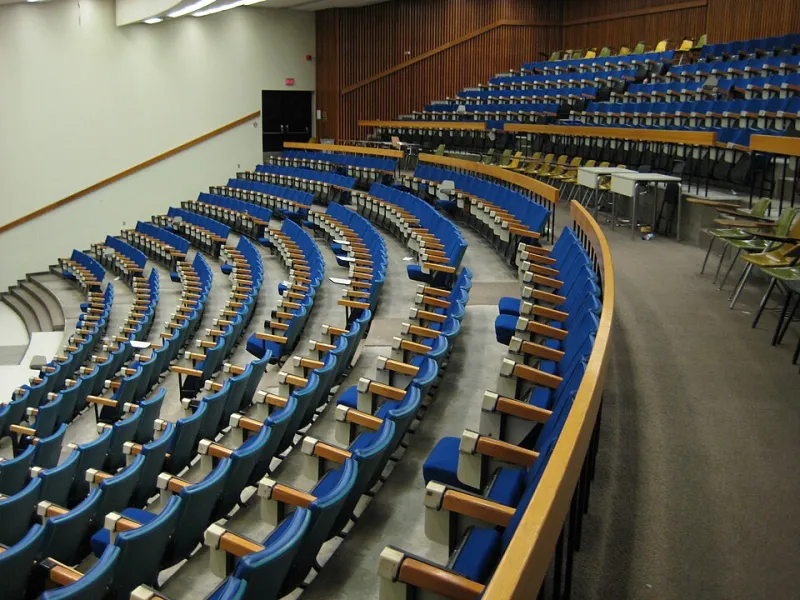
Photo: Theonlysilentbob, CC BY-SA 3.0, via Wikimedia Commons
There is a particular kind of silence that settles over a room when someone realizes the wrong opinion has been spoken aloud. It is not the silence of reflection. It is the silence of fear. That silence, once reserved for authoritarian regimes and ideological purges in distant lands, has become a defining feature of the American university campus.
The institution that was supposed to be the last sanctuary of free inquiry — the place where Socratic challenge was not merely permitted but demanded — has been quietly converted into something altogether different. It is now, in too many cases, a confessional booth where intellectual conformity is the price of admission and departure from approved doctrine invites consequences that can follow a person for years.
The Loyalty Test Nobody Acknowledges
Few administrators will openly admit that ideological conformity has become a hiring criterion. Fewer still will concede that it functions as an informal tenure filter. And yet the evidence accumulates with remarkable consistency.
The Foundation for Individual Rights and Expression — an organization that tracks campus speech incidents across the political spectrum — has documented hundreds of cases in recent years in which faculty members faced formal investigation, public denunciation, or professional sanction for expressing views that deviated from prevailing progressive consensus. The offenses range from questioning affirmative action's efficacy to raising empirical objections to gender ideology to simply inviting a conservative speaker without adequate disclaimers.
What is particularly instructive is not the high-profile cases that occasionally breach the mainstream press. It is the unreported ones — the junior professor who quietly removes a passage from a syllabus after a student complaint, the graduate student who rewrites a dissertation chapter to soften an inconvenient conclusion, the department chair who declines to defend a colleague because the political cost is too high. These are the invisible casualties, and they are legion.
A 2022 survey conducted by the Committee for Education Funding found that more than a third of faculty members across American universities admitted to self-censoring on at least one occasion in the previous academic year. Among those in humanities and social sciences — precisely the disciplines that shape how young Americans understand politics, history, and culture — the figure was substantially higher. This is not intellectual diversity. This is intellectual surrender dressed in institutional garb.
What Is Lost When Dissent Disappears
Conservatives have long understood something that the left's academic gatekeepers appear constitutionally incapable of grasping: the quality of any idea is tested by the quality of opposition it must survive. Steel sharpens steel. An argument that has never been genuinely challenged is not a refined argument — it is a comfortable assumption.
When conservative thought is systematically excluded from the university — not through formal prohibition, which would at least be honest, but through social pressure, hiring bias, and the quiet enforcement of orthodoxy — the entire enterprise of higher education is diminished. Students graduate having rehearsed only one set of responses to one set of approved questions. They enter civic life poorly equipped to engage with the roughly half of their fellow citizens who hold fundamentally different worldviews.
This is not merely an abstract concern about epistemology. It has direct political consequences. The administrators, journalists, lawyers, and policymakers produced by these institutions carry their intellectual formation into positions of real authority. When that formation has been stripped of genuine conservative challenge, the resulting professional class is not more enlightened — it is more insular, more brittle, and more prone to the kind of ideological overreach that has characterized so much of progressive governance in recent years.
Case Studies in Institutional Cowardice
Consider the experience of Professor Dorian Abbot at MIT in 2021. Abbot, a geophysicist with impeccable academic credentials, was disinvited from delivering a prestigious lecture series — not because of anything related to his scientific work, but because he had published an op-ed arguing that university admissions should prioritize merit over identity. The scientific community's response was largely one of shameful silence. MIT's administration offered no meaningful defense of academic freedom. The message to every untenured faculty member watching was unmistakable.
Or consider the broader pattern documented at institutions from Yale to the University of California system, where diversity statements have become de facto ideological screenings for faculty applicants. Candidates are asked not merely to describe their professional qualifications but to articulate their personal commitment to diversity, equity, and inclusion frameworks — frameworks that embed specific political assumptions about the nature of American society. Those who cannot or will not genuflect appropriately find their applications quietly set aside.
This is a loyalty test. It has no more legitimate place in an institution of genuine learning than a loyalty oath to any other political ideology would. The First Amendment, while not always directly applicable to private universities, embodies a principle of intellectual liberty that public institutions are constitutionally bound to honor and that all universities are morally obligated to respect.
The Conservative Obligation
For those of us who believe in constitutional principles, the university crisis is not merely a culture war skirmish. It is a structural threat to the kind of informed, self-governing citizenry that the Founders understood to be the indispensable foundation of republican government. James Madison did not envision a republic sustained by a population trained to accept received wisdom without examination. He envisioned one capable of the rigorous self-correction that only genuine intellectual contest can produce.
Conservatives must therefore resist the temptation to simply abandon higher education to its current custodians and build parallel institutions in isolation. That path leads to its own form of insularity. The better course — the harder course — is to fight for the restoration of genuine intellectual pluralism within existing institutions, to support legislation that conditions public university funding on demonstrable free speech protections, to defend faculty members facing ideological persecution regardless of their own political alignment, and to hold university boards of trustees accountable for the culture their administrations have permitted to flourish.
State legislatures in Florida, Texas, and elsewhere have begun moving in precisely this direction, enacting reforms that prohibit ideological litmus tests in faculty hiring and mandate meaningful free speech protections. These efforts deserve broader support and more aggressive implementation.
Reclaiming the Marketplace of Ideas
The American university was never meant to be a sanctuary from uncomfortable thought. It was meant to be the place where uncomfortable thought was most rigorously pursued. Restoring that purpose is not a concession to any particular ideology — it is a defense of the intellectual infrastructure that a free society cannot afford to lose.
The silence in those classrooms is not golden. It is corrosive. And the longer it persists, the more it corrodes not just the universities themselves, but the republic they were built to serve.